
Customization is one reason businesses consider sourcing a Chinese golf cart instead of buying a fixed configuration from a local distributor. Yet customization does not mean changing every component without limitation. Dealers, distributors, resorts, golf courses, and other commercial buyers need to understand which changes affect appearance, which influence vehicle performance, and which require a different configuration altogether.
Start With the Parts That Shape Market Appearance
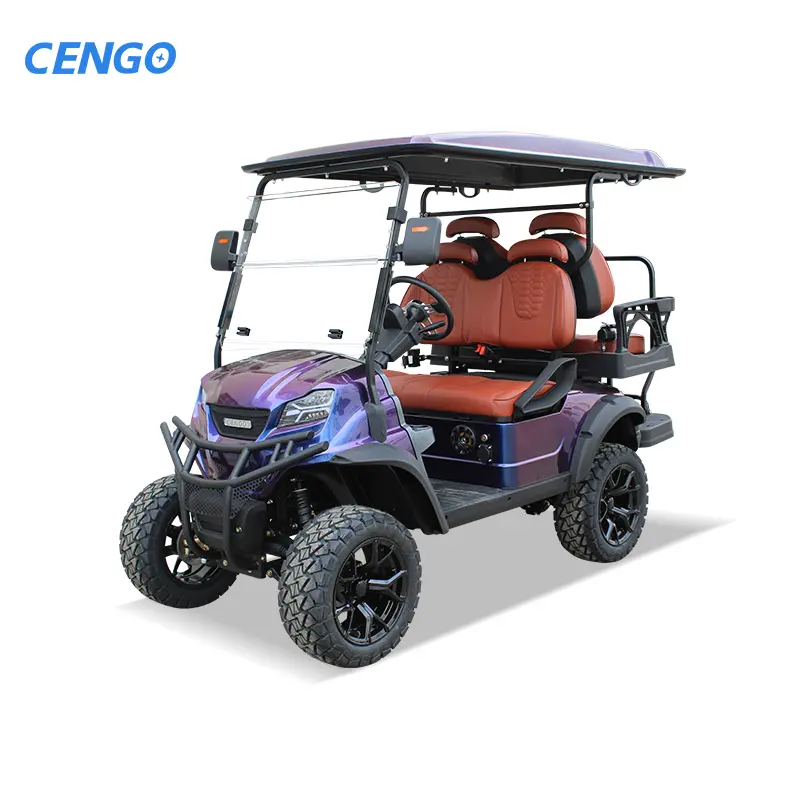
The simplest customization usually involves the parts customers see first. Body color, seat style, wheels, tires, and branding can change how a vehicle fits a dealer’s product range or a commercial fleet’s visual identity.
CENGO’s official materials specifically list colors, tires, logos, and the number of seats among its custom-service options. Its current golf cart range also includes several passenger configurations, giving buyers a starting point before discussing modifications.
For a distributor, this distinction matters. A familiar vehicle platform with different colors or branding can create a market-specific version without requiring an entirely new vehicle design.
Seat Configuration Can Change the Vehicle’s Purpose
Seat capacity is more than an appearance choice. Moving from a two-seat layout to a four- or six-passenger arrangement changes the way the vehicle is used, including available passenger space and overall configuration.
Our product range covers 2-seater, 4-seater, and 6-seater golf carts, as well as community and professional golf-course models. This gives commercial buyers several base configurations to evaluate before discussing a customized order.
A buyer sourcing a Chinese golf cart for a golf course may prioritize a different layout from a hotel transporting guests or a tourist attraction operating passenger shuttle vehicles. The intended application should therefore be established before selecting the seat configuration.
Wheels and Tires Need Technical Attention
Wheels and tires are another visible customization area, but they also have functional consequences. Tire dimensions, tread pattern, wheel material, and overall wheel-and-tire configuration can affect ground contact, ride characteristics, and suitability for different surfaces.
Our product information shows different tire configurations. When confirming these specifications, buyers can also review the vehicle’s suspension, ground clearance, and intended operating environment.
For electric golf carts used on golf courses, resorts, farms, or off-road properties, the right tire configuration depends on where the vehicle will operate. Importers should confirm the complete specification rather than selecting wheels from appearance alone.
Branding Is Useful for Fleet and Distribution Orders
Logo placement and body graphics are particularly relevant to B2B buyers. A dealer may want its own branding, while a resort, hotel, or tourist attraction may need vehicles that visually match its existing identity.
Our official product information identifies logo customization as an available option. When branding is part of an order, we can confirm the required artwork and application details with buyers before production. The exact customization method may depend on the vehicle and selected configuration, so we recommend confirming these details as part of the final order specification.
Performance Configuration Requires More Care
Not every customization should be treated as a cosmetic change. Motor, battery, controller, brakes, suspension, and other components influence how an electric golf cart operates. Changing one part can affect the relationship between several other systems.
For example, we offer lead-acid and lithium battery options on some golf cart models. Different models may also use different motor, controller, and frame configurations, which means performance-related customization needs to be confirmed against the specific vehicle. Buyers should verify the final battery, motor, controller, braking, suspension, and frame specifications before placing an order, so that all selected components correspond to the same complete vehicle configuration.
This is why an electric golf carts manufacturer should confirm a customized configuration as a complete vehicle specification. Importers should request the final motor, battery, controller, braking, suspension, tire, and frame details instead of approving individual components independently.
Body Design Can Support Product Differentiation
Body design is another area where customization can influence a dealer’s market position. A distinctive front or rear body design can make a vehicle easier to differentiate from standard models, especially when several suppliers offer similar basic vehicle layouts.
CENGO’s current golf cart range includes models with newly designed front and rear bodies, while its broader product portfolio covers golf carts, UTVs, sightseeing vehicles, and functional vehicles for different commercial applications.
However, a new body design should still be checked against the underlying chassis, lighting, seating, windshield, and other components. Appearance changes work best when they remain compatible with the vehicle’s mechanical and electrical systems.
Define Customization Before Ordering
For a B2B order, the most useful approach is to separate customization into three levels: appearance, configuration, and application. Appearance can include colors, seats, wheels, tires, and logos. Configuration may involve battery or motor choices. Application requirements determine which base vehicle is appropriate in the first place.
We recommend confirming these details before production rather than relying on photographs or informal descriptions. The final quotation should correspond with an agreed specification covering quantity, seating, battery, motor, wheels, tires, branding, and other selected options.
CENGO currently operates as an electric golf carts manufacturer with golf carts and other electric vehicles designed for commercial applications and customization.
Post time: Sep-20-2026


