
Hotels and resorts often cover much more ground than guests realize. Rooms, restaurants, pools, parking areas, villas, event spaces, beaches, and recreational facilities may all be separated by considerable distances. Walking is not always practical, while full-size vehicles can be excessive for short internal routes. This is where electric golf carts can become part of a property’s daily transportation system.
For hotel operators, the purchasing question is not simply which cart looks attractive. The more useful approach is to match passenger capacity, route conditions, battery configuration, driving performance, and vehicle layout with actual guest transportation needs.
Start With the Property Layout
The first specification to consider is the route itself. A compact resort with short paved paths has different requirements from a large property with slopes, uneven surfaces, long guest transfers, and multiple pickup points.
Before comparing electric golf carts, fleet managers can map the most frequently used routes and record approximate distance, slope, passenger volume, surface conditions, and peak transportation periods. This information gives the purchasing team a practical reference when comparing motor output, battery options, seating capacity, and suspension systems.
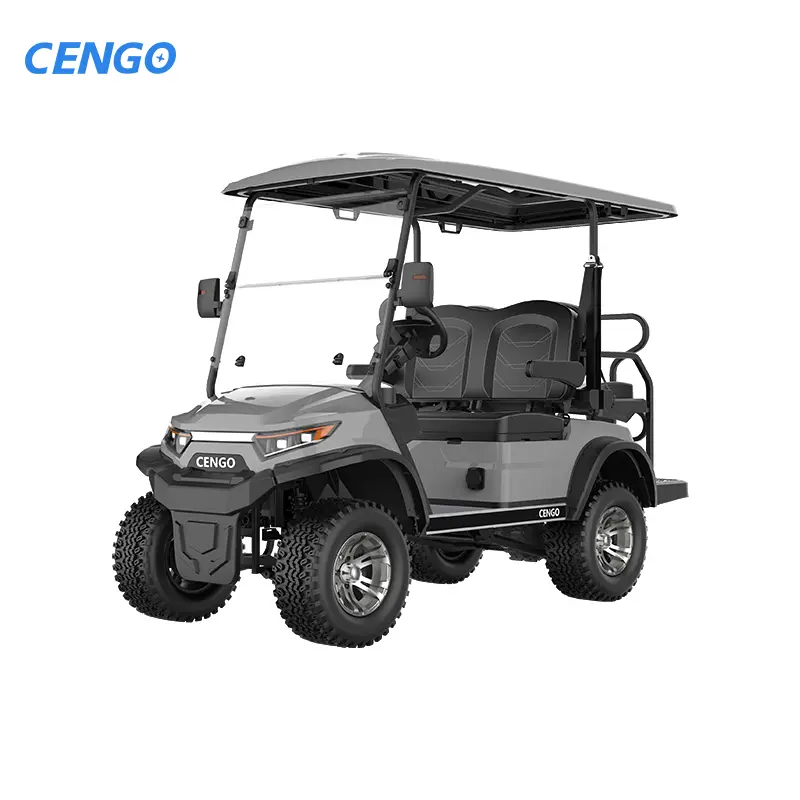
Our community-model range includes four-seat, six-seat, and other configurations, giving commercial buyers different starting points depending on passenger demand. The range includes the NL-LC4+2, NL-LCB4G, NL-LC2+2G, and street-legal NL-JZ4+2G.
Passenger Capacity Should Match the Service
A common mistake is choosing capacity based only on the maximum number of seats. Hotels should also consider luggage, staff use, boarding frequency, and whether the cart will operate primarily as a guest shuttle or as a general-purpose property vehicle.
A four-seat electric golf cart may be suitable for smaller guest transfers and routine movement between nearby facilities. Six-seat configurations can make more sense on routes with higher passenger demand because fewer individual trips may be needed. However, a larger vehicle also requires sufficient turning space, parking space, and charging capacity.
This is why seating should be considered alongside the property’s road width and operating schedule. A higher-capacity model is not automatically the more practical choice for every resort.
Powertrain Performance Matters on Resort Roads
Resort routes are rarely completely flat. Even when the overall property appears level, ramps, parking entrances, landscaped areas, and elevated facilities can create repeated uphill sections. Passenger loads can further change how a golf cart behaves on these routes.
The community models listed by us use 48V KDS motors, with the product information describing stable and powerful uphill operation. They also support either lead-acid or lithium battery configurations, depending on the model. Quick and efficient charging is another listed feature across these community models.
For buyers, the important lesson is to compare actual motor and battery specifications rather than judging performance from appearance. A fleet that regularly carries guests across slopes should be evaluated under realistic passenger loads and route conditions.
Battery Planning Is a Fleet Decision
Battery selection should be connected to daily operating patterns. A resort may have vehicles running continuously during check-in periods, restaurant transfers, pool transportation, and evening activities. Charging opportunities therefore need to be considered before the order is finalized.
Lithium and lead-acid systems can have different purchasing, charging, maintenance, and replacement considerations. Our community models list both options, allowing buyers to discuss the appropriate configuration according to their operating requirements.
Instead of asking only about driving range, procurement teams should estimate daily mileage, average passenger load, charging windows, number of shifts, and the number of spare vehicles available. This produces a much more useful fleet-sizing calculation.
Guest Comfort Includes More Than Seating
Guest transportation is also part of the property’s service environment. Noise, ride movement, weather exposure, boarding convenience, storage, and the visual condition of the vehicle can all influence how transportation fits into the guest experience.
Several CENGO community models feature a two-section folding front windshield and a storage compartment. These details have practical value on resort properties where weather can change during the day and drivers may need convenient storage during repeated passenger transfers.
Exterior appearance also deserves attention when vehicles operate in visible guest areas. Color, body design, seating configuration, and branding can be considered as part of the property’s overall transportation presentation rather than treated as purely cosmetic decisions.
Build the Order Around Daily Operations
For B2B buyers, the vehicle itself is only part of the purchasing calculation. Delivery timing, configuration consistency, warranty terms, spare parts, customization, and future replenishment can influence the total value of a fleet order.
We recommend defining the intended use of each vehicle before requesting a quotation: guest shuttle, villa transfer, staff transportation, event support, or mixed property use. The purchasing team can then compare electric golf carts using the same criteria instead of selecting different models based on appearance or price alone.
CENGO serves commercial applications across hotels, resorts, golf courses, communities, airports, and other properties, while its wider portfolio covers golf carts, UTVs, sightseeing vehicles, and functional electric vehicles.
For hotel and resort operators, the most useful purchase is ultimately the configuration that matches the property’s routes, passenger flow, charging routine, and service requirements; we at CENGO develop golf carts and other electric vehicles with configurable options for commercial transportation needs.
Post time: Sep-15-2026


