
Choosing the battery system is an important part of specifying an electric golf cart for commercial use. A golf course, hotel, resort, campus, community, or tourist attraction may run vehicles through repeated short-distance trips, making charging time, usable range, vehicle weight, and daily operating patterns important considerations. Battery selection should therefore be treated as part of fleet planning rather than simply a technical upgrade.
For a 4 seater golf cart, battery selection should balance passenger capacity with operating efficiency. A four-seat configuration can carry several passengers while the battery system influences daily charging and operating requirements.
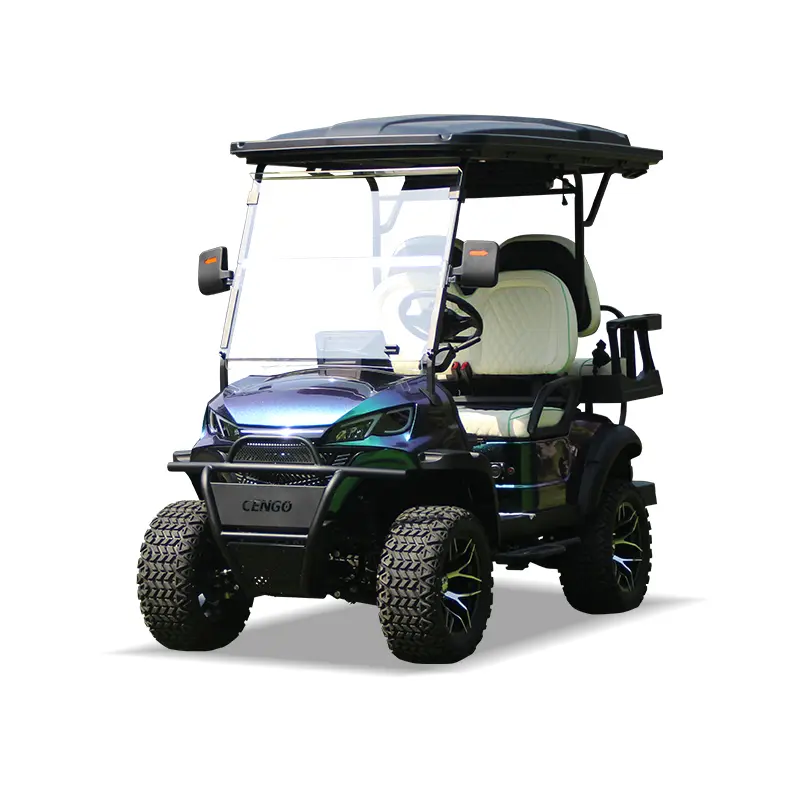
Why Lithium Matters in a 4 Seat Electric Golf Cart
Lithium-ion batteries have become an increasingly common option in electric vehicle applications because their characteristics differ from traditional lead-acid systems. Battery chemistry affects factors such as weight, charging behavior, usable capacity, maintenance requirements, and service life, so buyers should evaluate the complete battery system instead of comparing capacity numbers alone.
Our current four-seat product range includes models where lithium batteries are available as an option. For example, the NL-WD2+2.G and NL-JZ4+2G product pages list both lead-acid and lithium battery configurations. This means fleet buyers can consider battery chemistry when matching a 4 seat electric golf cart to its intended operating pattern rather than being restricted to one standard configuration.
Start With Daily Energy Requirements
Battery selection should begin with actual vehicle use. A fleet manager can estimate daily energy demand by recording the number of trips, approximate distance per trip, passenger load, terrain, and operating hours. Charging opportunities should also be included because a vehicle with access to scheduled charging can have different requirements from one operating continuously throughout a long shift.
Terrain is another variable. A four-seat vehicle operating on relatively flat paved routes has a different workload from one regularly climbing slopes or moving across outdoor areas. Our NL-JZ4+2G, for instance, is listed with a 48V KDS motor and a 20% grade ability, illustrating why motor, battery, and route conditions should be considered together when configuring a fleet vehicle.
Charging Time Can Affect Fleet Scheduling
Charging is not simply a battery specification; it is part of fleet scheduling. If several vehicles return to the same charging area at similar times, the operator needs to consider charger availability, charging duration, and vehicle dispatch requirements. A fleet with poorly planned charging can experience unnecessary downtime even when its vehicles have suitable battery capacity.
CENGO’s four-seat product information emphasizes quick and efficient battery charging on several models. For commercial buyers, the practical question is how that characteristic fits the site’s operating schedule. Mapping vehicle use across a full day can reveal whether charging should take place overnight, during breaks, or in other planned intervals.
Weight and Passenger Load Should Be Considered Together
Battery choice also interacts with the vehicle’s overall operating characteristics. Four passengers, luggage, equipment, and accessories can increase the load compared with an empty vehicle. On campuses, resorts, airports, and tourist properties, passenger movement may also vary considerably between ordinary operating periods and peak events.
This is why a 4 seater golf cart should be evaluated under realistic operating conditions rather than only through specifications measured without passengers. Buyers should consider passenger capacity, terrain, acceleration requirements, braking, suspension, and battery configuration as a connected group of factors.
Lithium Does Not Make Every Configuration Identical
It is important not to assume that every lithium-equipped vehicle has the same performance. Battery voltage, capacity, motor output, controller characteristics, vehicle weight, tire configuration, and other components all influence how an electric vehicle operates.
Our product range illustrates this point. CENGO offers multiple four-seat configurations, including professional golf-course and street-legal-oriented models, while the wider product portfolio also includes six-seat golf carts, UTVs, sightseeing vehicles, and functional electric vehicles. Buyers should therefore select the exact model and configuration according to its intended application.
Consider the Commercial Ownership Cycle
For B2B buyers, battery selection should extend beyond the initial vehicle quotation. Dealers and distributors need to consider what configuration suits their local market, while golf courses, hotels, resorts, airports, and community operators need to consider service intervals, charging arrangements, replacement planning, and expected utilization.
Warranty coverage is another procurement consideration. CENGO currently states that its batteries carry a five-year warranty and vehicle bodies an 18-month warranty. Buyers should still review the applicable warranty terms for the specific vehicle and battery configuration before placing an order.
Build the Specification Around the Application
A useful purchasing process starts by defining the job of the vehicle. A hotel may prioritize comfortable passenger movement between buildings, while a golf course may focus on course conditions and repeated daily use. A community shuttle may have different requirements again, particularly when operating on fixed internal routes.
Our four-seat range includes different configurations, and lithium battery availability can be considered alongside the motor, suspension, body design, and intended application. This approach gives commercial buyers a clearer basis for comparing specifications and planning their fleet.
Lithium integration is ultimately a fleet-planning decision: the right configuration depends on passenger demand, daily mileage, terrain, charging arrangements, operating hours, and long-term ownership considerations. At CENGO, we develop four-seat and other electric vehicles for commercial applications, with lithium options, customization capabilities, international certifications, and after-sales warranty support forming part of our broader vehicle offering.
Post time: Sep-07-2026


