
Buying an off road golf cart for a dealership, golf course, resort, or commercial fleet requires more than comparing the exterior and quoted price. The vehicle is a combination of systems, and each part affects operation, maintenance, and the final configuration. Understanding these components makes it easier to compare suppliers and avoid choosing an off road golf cart based only on appearance.
Start With the Powertrain
The motor is one of the first parts to examine because it determines how the vehicle responds to slopes, passenger loads, and repeated operation. Buyers should check the motor voltage, rated output, climbing capability, and whether the specification matches the intended terrain.
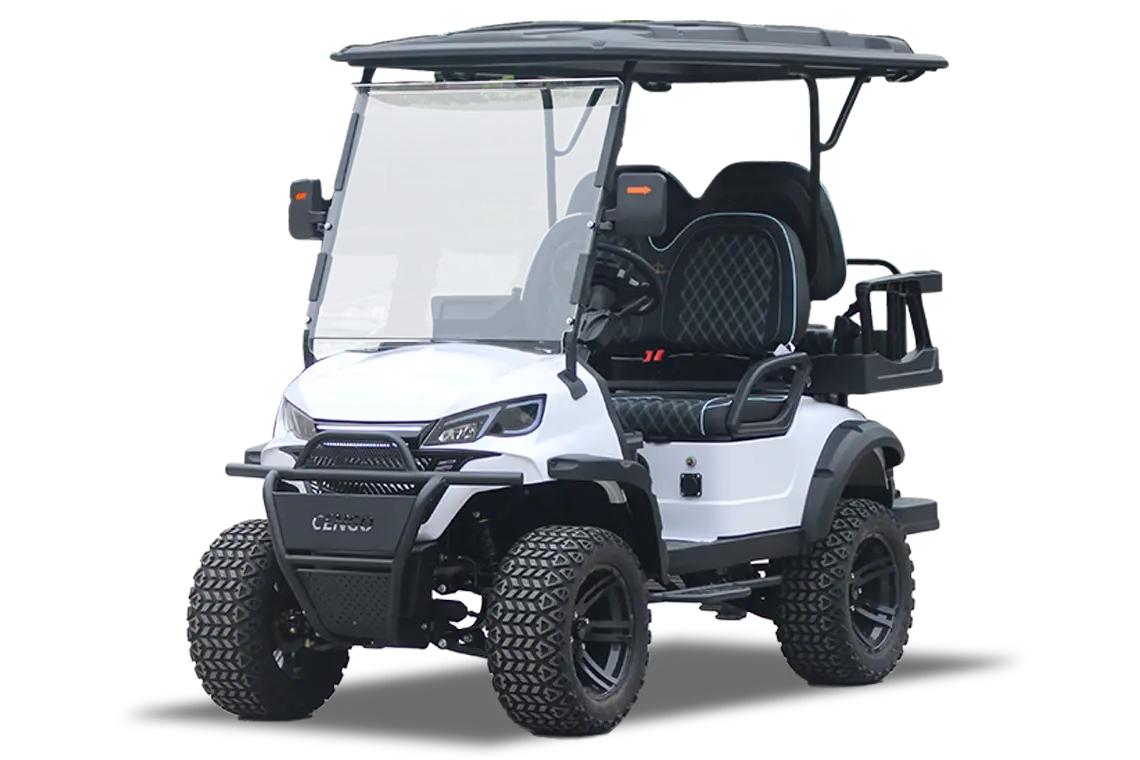
Our NL-JA2+2G, for example, uses a 48V KDS motor and is rated with a 20% grade ability. The model is designed for golf courses and competitions, where vehicles may need to move across larger properties and negotiate slopes. Its listed speed is 15.5 mph, with four seats and 6.67 hp.
For fleet procurement, these figures are more useful than general descriptions such as “powerful” or “high performance.” Comparing measurable specifications gives dealers and operators a clearer basis for selecting an off road golf cart.
Battery Choice Changes Fleet Planning
Battery selection should be considered together with daily operating hours, charging facilities, vehicle utilization, and maintenance plans. Lead-acid and lithium batteries can create different purchasing and operating considerations, so buyers should confirm which battery types are available for the exact model rather than assuming that every vehicle in a product range uses the same setup.
The NL-JA2+2G supports both lead-acid and lithium battery options. Its official specification also highlights quick and efficient charging, which is relevant when vehicles need to return to service during a busy operating schedule.
For wholesalers and distributors, battery configuration can also affect the SKU strategy. Keeping several battery versions may serve different markets, but standardizing configurations where possible can simplify inventory, training, and after-sales support.
Suspension Is a Key Off-Road Component
An off road golf cart needs more than a suitable motor when it operates on uneven ground. Suspension determines how the vehicle responds to surface changes and impacts both handling and ride characteristics. Buyers should therefore look beyond the simple description of “independent suspension” and check the actual structure.
The NL-JA2+2G uses a double-cantilever front suspension with coil springs and cylinder hydraulic shock absorbers. At the rear, it combines an integral rear axle, a 12.31:1 speed ratio, a rear trailing arm, coil spring shock absorption, and a cylinder hydraulic shock absorber.
This level of specification is useful when comparing off road golf carts for different operating environments. A buyer can assess whether the suspension architecture corresponds with course conditions, route surfaces, expected passenger loads, and service requirements instead of relying only on a visual inspection.
Steering and Brakes Deserve Equal Attention
Steering and braking parts are sometimes overlooked when buyers focus heavily on motors and batteries. In commercial fleets, however, these systems directly affect vehicle control and daily operation.
Our selected model uses a bidirectional rack-and-pinion steering system with automatic clearance compensation. Its braking system consists of dual-circuit four-wheel hydraulic brakes, four-wheel disc brakes, and an EPB electronic parking system.
When comparing an off road golf cart, procurement teams should check the steering mechanism, brake configuration, parking system, and replacement-part availability. These details can influence maintenance planning over a fleet’s operating life.
Body Parts Also Affect Commercial Use
Body components are not only about styling. Windshields, dashboards, storage areas, seats, lights, and control interfaces can affect how a vehicle fits a specific business application.
The NL-JA2+2G has a two-section folding front windshield, a molded instrument panel, a cup holder, Type-C and USB ports, an electronic parking switch, and a storage compartment. The control area also includes switches for gears, while an optional one-button start system is available.
For dealers and project buyers, these details can make configuration more practical. A golf course may prioritize windshield flexibility and storage, while a resort or commercial property may pay greater attention to passenger presentation, charging arrangements, and exterior customization.
Match Parts With the Intended Fleet
There is no single parts combination that suits every buyer. A distributor selling recreational vehicles may prioritize appearance and configuration flexibility, whereas a golf course operator may place greater emphasis on climbing ability, suspension, braking, and battery selection.
At CENGO, we offer the NL-JA2+2G as a professional off-road golf cart for golf courses and competitions. Our wider range also covers golf carts, UTVs, sightseeing vehicles, and functional vehicles, giving buyers different vehicle categories to consider based on their intended applications rather than viewing every off road golf cart as the same type of vehicle.
Before placing an order, buyers should therefore compare the complete specification sheet, available battery options, key chassis components, configuration choices, replacement parts, warranty terms, and expected delivery schedule. CENGO states that the NL-JA2+2G has a MOQ of 2+, with samples or stocked units listed at seven days after payment and mass orders at four weeks after deposit.
A component-based evaluation gives dealers, distributors, golf courses, resorts, and other commercial buyers a clearer way to judge whether an off road golf cart fits their market and operating conditions; we at CENGO manufacture golf carts and other electric vehicles with configurable solutions for professional and commercial applications.
Post time: Sep-14-2026


