
Selling off-road electric vehicles across different markets requires more than selecting a popular body style. Dealers and distributors must consider terrain, passenger capacity, battery preferences, local regulations, accessories, shipping arrangements, and after-sales requirements. A vehicle that works well for a resort may not have the same specification needed by a farm, outdoor attraction, or commercial property.
This makes wholesale sourcing a configuration exercise. When evaluating an off road golf cart, buyers should first identify the application and then work backward toward the appropriate vehicle, powertrain, suspension, and equipment package.
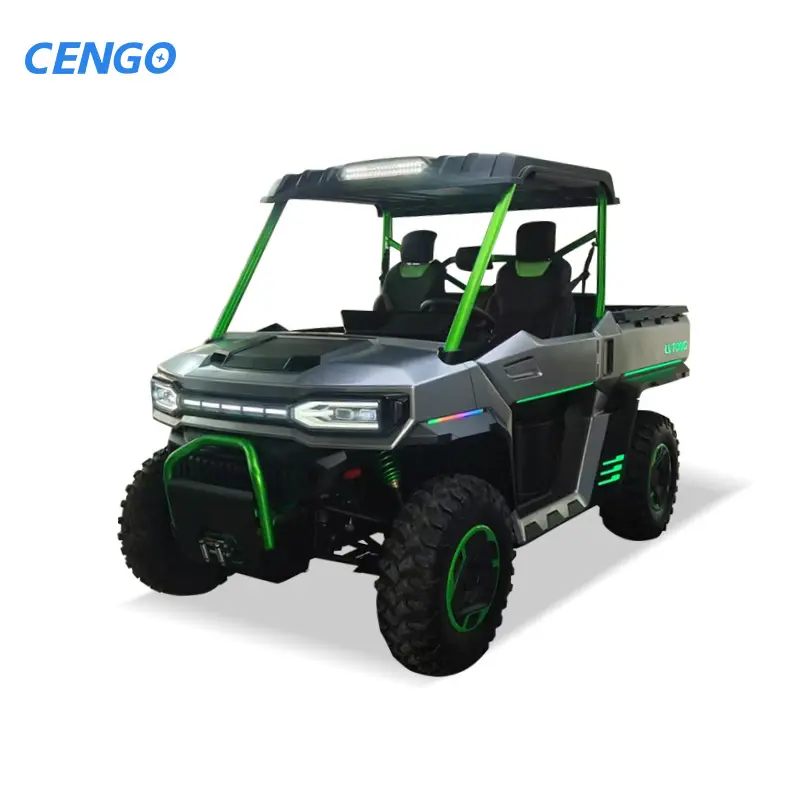
Build the Specification Around the Market
Different markets can have very different expectations. Some customers may prioritize passenger transportation, while others need utility functions or stronger off-road capability. Even within the same country, a golf course, farm, hotel, and outdoor recreation business can require different vehicle configurations.
Our current UTV range includes the NL-F12, NL-4WD.P, and NL-604F. Their configurations are not identical: the NL-4WD.P, for example, lists a 15KW or 6.67hp motor, while the NL-604F uses a 48V KDS motor. This makes model selection an important first step when sourcing an off road golf cart for wholesale distribution.
Match Drivetrain to the Intended Terrain
Off-road capability should be evaluated through several specifications rather than a single horsepower figure. Grade ability, motor output, suspension, tires, vehicle weight, and drivetrain all influence how a vehicle behaves on uneven or sloping ground.
The NL-4WD.P is listed with a 20% grade ability and a 15KW or 6.67hp motor, while the NL-F12 uses a high-performance 48V KDS motor and spiral damping springs. These differences give wholesalers useful reference points when deciding which configuration fits a particular customer segment.
For an off road golf carts for sale program, the same principle applies to inventory planning. Rather than stocking vehicles based only on appearance, distributors can group models according to their typical application, such as passenger transport, recreational use, property mobility, or utility work.
Battery Options Affect the Wholesale Package
Battery selection can influence both the product specification and the customer’s operating routine. Daily distance, terrain, charging access, expected utilization, and maintenance preferences should all be considered before confirming the battery configuration.
At CENGO, we currently offer both lead-acid and lithium battery options for the NL-4WD.P and NL-604F. We also emphasize convenient charging as part of the vehicle configuration. For wholesale buyers, this means battery choice can become part of market segmentation: some customers may prioritize a familiar battery system, while others may request lithium as part of a newer fleet specification.
Suspension Deserves a Place in the Purchase Checklist
Off-road vehicles encounter repeated vibration and impacts that are less significant on smooth paved routes. Suspension therefore deserves the same attention as the motor and battery.
The NL-4WD.P uses double swing-arm independent front suspension with coil springs and hydraulic shock absorbers, while its rear system includes an integral rear axle, coil spring shock absorbers, hydraulic shock absorbers, and a rear stabilizer bar. These details give distributors something concrete to compare when selecting an off road golf cart for different operating environments.
Customization Should Follow Customer Demand
Wholesale customization works best when it is connected to identifiable market requirements. A dealer might need a particular body color or logo, while a resort operator may want a specific seating arrangement or accessory package. Adding features without considering their effect on weight, maintenance, and cost can make a fleet harder to manage.
We offer customization options covering colors, tires, logos, seating numbers, branding, electronic features, and personalized paint schemes. This gives wholesale buyers room to adapt an off road golf carts for sale range to different customer segments rather than treating every order as identical.
Check Braking and Controls Before Bulk Ordering
A wholesale buyer should inspect the complete driving system before committing to a larger order. Steering, braking, dashboard layout, parking systems, and driver controls influence everyday operation and should be suitable for the intended users.
The NL-604F, for example, is listed with four-wheel hydraulic disc brakes, an electric-vacuum booster, and an EPB electronic parking brake. Its adjustable steering wheel and bidirectional rack-and-pinion steering system also include automatic clearance compensation. Such specifications are useful when comparing different UTV configurations at the procurement stage.
Lead Time Matters After the Technical Review
Once the specification is established, wholesalers should examine production and delivery arrangements. Inventory planning becomes particularly important when customers expect repeat orders or when seasonal demand creates short purchasing windows.
CENGO’s current NL-604F product page states that samples or stocked units can be available in seven days after payment, while mass orders are listed at four weeks after deposit. The same page states that standard models typically ship within four to six weeks, although delivery depends on order details. Buyers should confirm the current schedule before placing an order.
For global distributors, a useful purchasing checklist is therefore: application, terrain, passenger or cargo needs, battery type, suspension, braking, customization, quantity, lead time, warranty, and destination-market requirements. At CENGO, we manufacture golf carts, UTVs, sightseeing vehicles, and functional vehicles, with configurable products and OEM/ODM services supporting dealers, distributors, resorts, farms, airports, and other commercial customers.
Post time: Sep-13-2026


